
Marketplaces and Publishers Take Note: The Age of AI Search Agents Has Arrived
Why This Matters Now
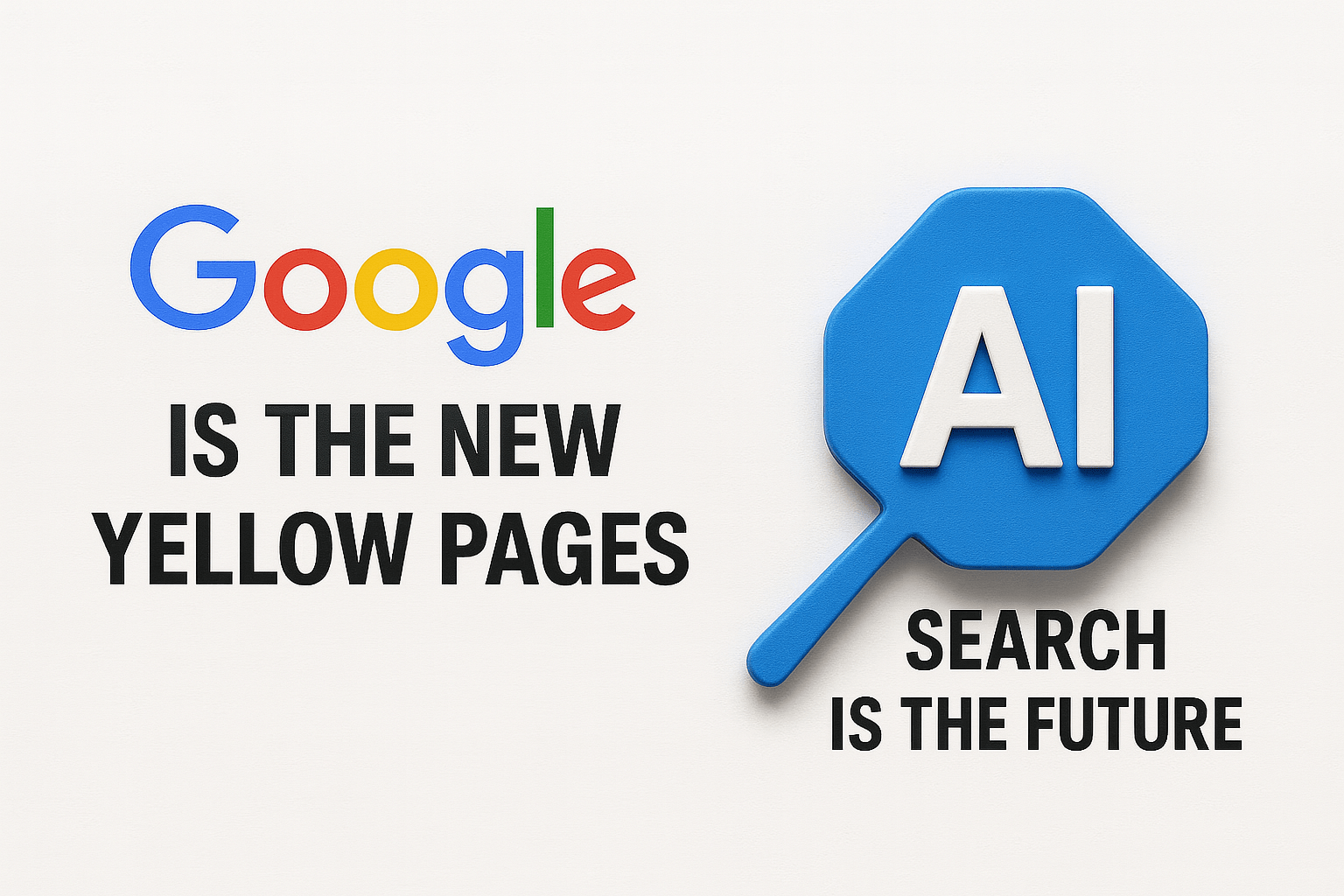
For decades, publishers and marketplaces have optimised for visibility—first in the physical Yellow Pages, then on Google. But just like those phone books faded into irrelevance, traditional search strategies are on the same path.
This year marked a tipping point:
- OpenAI announced its own AI browser, combining ChatGPT’s conversational intelligence with live browsing. It directly challenges Chrome’s dominance and redefines the way users find information online.
(Reuters, July 2025) - Perplexity CEO Aravind Srinivas captured the shift: “Search is fundamentally broken. People don’t want 10 blue links — they want answers.”
(Fast Company, May 2024) - Google is evolving too, replacing traditional results with AI-generated summaries through its Search Generative Experience (SGE). This further reduces traffic to external sites—even if you still “rank.”
- And this should keep every publisher and marketplace executive up at night:
- Claude’s crawl-to-click ratio: 6,000:1
- ChatGPT’s: 250:1
- Google’s historical average: 2:1
(Source: IAB Tech Lab)
Cloudflare CEO Matthew Prince warned recently:
“AI bots are sucking in data from the open internet, but publishers aren’t seeing any value in return. That’s not sustainable.”
From Search Bar to AI Concierge: The New Discovery Layer
Consumers are no longer “searching” in the traditional sense. They’re delegating.
AI agents (like ChatGPT, Claude, and Perplexity) are becoming digital intermediaries that users trust to:
- Find, filter, and summarise answers
- Compare products, services, and content
- Even initiate bookings, purchases, or sign-ups
If your business isn’t visible to the agent, it may never be seen by the customer.
The Collapsing Customer Journey
AI doesn’t just accelerate discovery—it collapses the traditional multi-step funnel. What used to unfold over multiple clicks, sessions, and touchpoints now happens in a single prompt.
| Stage | Traditional Journey | AI-Driven Journey | Impact on Publishers & Marketplaces |
|---|---|---|---|
| 1. Discovery | Google search, SEO clicks | AI agent prompt & response | Traffic diverted before it reaches you |
| 2. Research | Browsing articles, tools, reviews | Instant summary from scraped sources | No attribution, no session depth |
| 3. Comparison | User-driven cross-checking | Curated results from multiple platforms | UX and product differentiation bypassed |
| 4. Evaluation | Click into listings, filter or sort options | Answer delivered within chat interface | Engagement and brand experience lost |
| 5. Engagement | Form fill, enquiry, cart add | Action directed elsewhere or ends in agent | No data capture, no CRM entry |
| 6. Conversion | Purchase or lead via your platform | Off-site or agent-initiated outcome | Revenue, attribution and remarketing lost |
SEO Is No Longer Enough
Optimising for ranking used to be the path to visibility. But AI doesn’t deliver “Page 1”—it delivers a single answer.
If you’re not in the answer, you’re not in the query.
AI platforms are ingesting content at scale, with little return to the originator. And even Google’s shift toward AI summaries mimics this pattern—users get what they need without clicking anything at all.
What Does a Refocus from SEO to AI Search Look Like?
Marketplaces and publishers need to evolve from optimisation to orchestration:
- 🔁 From keywords to concepts – Structure content semantically for LLMs
- 📡 From clicks to crawl control – Use
llms.txt, fingerprint AI agents, limit unlicensed access - 🧩 From ranking to referencing – Ensure your content is recognised and retrievable as a source
- 💰 From free access to monetised licensing – Adopt CPCr (Cost Per Crawl) or private API terms
- 🧭 From SEO to AI Governance – Layer in consent signals, compliance tags, and enforce usage terms
Strategic Response: Future-Proofing Starts Now
Here’s what publishers and marketplaces should prioritise:
1. Control Your Crawl Surface
Define clear permissions with robots.txt and llms.txt. Use infrastructure like Cloudflare to enforce access.
2. Monetise the Content Layer
Don’t give away your IP. Monetise structured content via CPCr or API integrations.
3. Strengthen Attribution and Governance
Embed metadata, licensing signals, and audit trails for content ingestion.
4. Build First-Party Relationships
Invest in newsletters, loyalty, and CRM—not just traffic.
5. Embed Into the AI Stack
Ensure your platform is a data source—not just a scraped site—by structuring content in LLM-compatible formats.
Final Thought & Call to Action
AI isn’t just disrupting search. It’s replacing the interface between user and information. If Google is the new Yellow Pages, then AI agents are the next concierge—and they’re not sending traffic back.
📩 Contact FMA Consulting to discuss how to:
- Govern and protect your content
- Prepare for AI-led discovery
- Stay visible, valuable, and monetised in an AI-first world
Let’s make sure your platform remains part of the answer—not left behind in someone else’s summary.performance metrics.
📌 Frequently Asked Questions
AI search agents like ChatGPT, Claude, and Perplexity summarise answers instead of listing links, reducing website traffic and rendering traditional SEO strategies less effective.
Google SGE delivers AI-generated summaries directly in search results, bypassing external sites and decreasing click-through rates for publishers and marketplaces.
AI agents crawl and summarise content without attribution or monetisation, which limits user engagement, disrupts conversion funnels, and reduces ad or lead revenue.
Publishers can use tools like llms.txt, fingerprint AI bots, and enforce licensing models like CPCr (Cost Per Crawl) to control and monetise access to their data.
Shifting from keyword optimisation to content orchestration, structuring content semantically for LLMs, and embedding governance signals are key to staying visible in AI-led search environments.
Great question. Maybe not for long. As large language models replace search engines, the real challenge isn’t ranking on Page 1 — it’s being in the answer. Structured FAQs might help today, but tomorrow’s visibility will depend on how well your content feeds the machine, not how well it flatters the algorithm.
Leave a Reply